March 2026 marks a slightly absurd, deeply beautiful anniversary.
Twenty-five years ago, a number became illegal.
Not a weapon. Not malware. Not stolen data.
A prime number.
DVDs should be for everyone
If you weren’t online at the turn of the millennium, this might sound like a bad joke or a crypto-bro fever dream. But for those of us who were there – lurking on mailing lists, IRC, forums, and half-broken personal homepages – it was very real. A moment where the internet collectively decided that if math was outlawed, then math would be everywhere.
This story begins with Jon Lech Johansen, better known as DVD-Jon (and, if rumours are true, two of his friends that has been anonymous to this day). A teenager who did something unforgivable in the eyes of the movie industry: he wanted to watch DVDs on Linux (we all did). Back then, DVDs were wrapped in CSS (Content Scramble System), a deliberately weak encryption scheme guarded more by lawyers than cryptography. DeCSS broke it open. Not to pirate movies, but to enable interoperability and freedom on platforms Hollywood didn’t care about.
That distinction mattered to us. It mattered a lot!
The response from the industry was swift, heavy-handed, and spectacularly short-sighted. Lawsuits. Raids. Threats. The full weight of the DMCA era crashing down on a teenager and a few hundred lines of C code. The message was clear: this wasn’t about piracy – it was about control.
And that’s where the internet underground woke up.
What followed was one of those rare, formative internet moments where everything aligned. Hackers, academics, free-software people, artists, cryptographers, and professional troublemakers all pushed back – not with riots, but with creativity. DeCSS was mirrored everywhere. Printed on T-shirts. Embedded in haikus. Turned into music. Translated into images. Hidden in fonts.
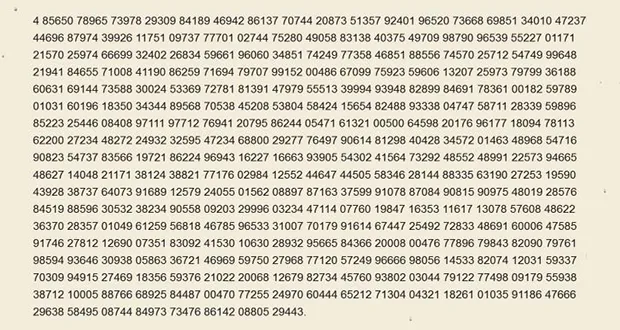
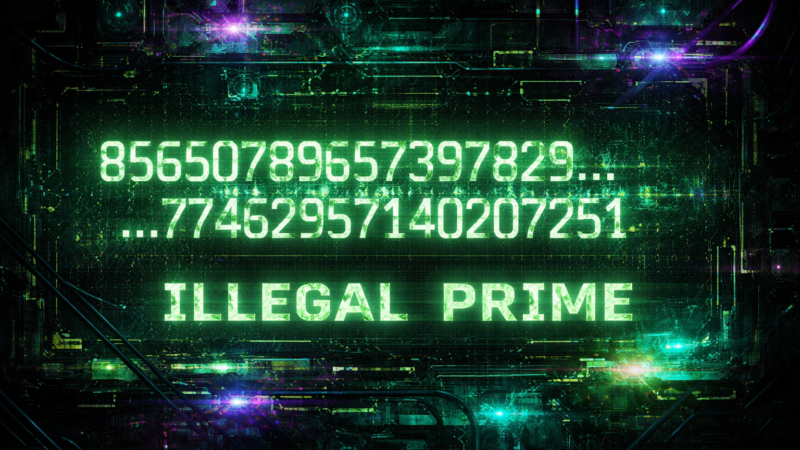
And then someone noticed something magical: if you interpret the DeCSS code as a binary number, it can be expressed as a large prime.
A prime number – Illegal prime number
Which meant that, by the logic of the lawsuits, a number was illegal.
That realization hit like a spark in dry grass. Because if a number could be illegal, then the law had wandered far outside reality. Maths doesn’t negotiate. Primes don’t care about copyright. You can’t un-invent a number.
Posting that prime felt like rebellion – and strangely like charity work at the same time. You weren’t just defying bad law; you were preserving knowledge. Being part of that felt righteous. You weren’t stealing – you were defending the idea that understanding how things work is not a crime.
I still remember the feeling. That low-grade adrenaline buzz of doing something technically trivial but politically radioactive. Hitting “publish” and knowing that, in some small way, you were part of a distributed middle finger aimed squarely at corporate overreach.
And it worked.
Not immediately. Not cleanly. But inevitably.
Jon Lech Johansen was ultimately acquitted. The sky did not fall. DVDs did not vanish. But something fundamental shifted. The case exposed just how brittle the old gatekeepers were when confronted with a network that routes around damage – and around censorship.
Looking back from 2026, the irony is thick. DRM is still with us, but DVDs are largely irrelevant. Streaming replaced discs, platforms replaced ownership, and control simply moved higher up the stack. The battlefields changed, but the lesson remains painfully current: when laws try to outlaw understanding, they lose legitimacy.
That illegal prime is still out there. Still perfectly valid. Still prime. Still quietly mocking the idea that knowledge can be contained once it’s been shared.
Twenty-five years on, it’s worth celebrating not just a clever hack or a famous court case, but a moment when the internet remembered what it was good at: collective resistance through creativity, humour, and an unshakeable belief that math belongs to everyone.
Happy anniversary, you beautiful, unlawful number.