My inbox has been a noisy place since publishing the teardown of Meshtastic. A significant portion of you agreed that building serious communication infrastructure on a flooding algorithm is a bad idea. An equally vocal faction immediately pointed at MeshCore as the obvious savior. You wanted an audit of where it fits between the chaotic simplicity of Meshtastic and the steep learning curve of Reticulum.
To Relay or not to Relay – That is the question
MeshCore presents itself as a pragmatic middle ground. The core routing protocol and firmware from meshcore.io are completely open under the MIT license. It promises the routing efficiency that Meshtastic lacks while maintaining a user interface you can actually hand to a normal person.
The mechanism it uses to achieve this efficiency is fascinating. It abandons the idea of a flat mesh entirely.
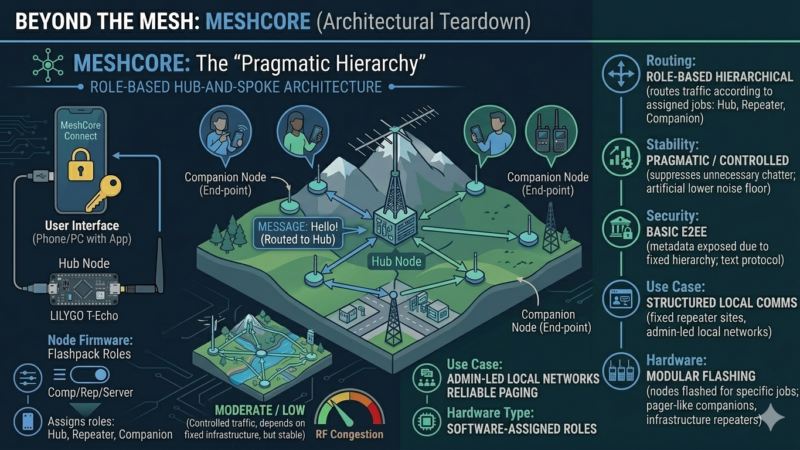
To solve the broadcast storms that plague managed flooding, MeshCore introduces strict, role-based routing. When you flash a device, you assign it a job. A radio becomes a Companion, a Repeater, or a Room Server. Companions are deaf to the wider network traffic; they only speak directly to Repeaters. This effectively recreates a 1990s Bulletin Board System over 868MHz LoRa.
This is brilliant triage for the physical limitations of low-bandwidth radio. By forcing a rigid hierarchy, MeshCore artificially lowers the noise floor. Your pocket device stops trying to act like a network switch and just acts like a pager. RF congestion drops immediately, making it incredibly stable in dense urban environments where a standard mesh would collapse under its own weight.
The Hub-and-Spoke regression
But this stability exacts a heavy structural cost. It is a severe regression for decentralized infrastructure.
When you mandate rigid roles, you recreate legacy hub-and-spoke telecom topology. You are introducing single points of failure by design. If the designated Repeater on the roof loses power, the dozen Companions in the building below go totally dark to the world around them but can only talk to each other if in RF range(Corrected from: even if they are in physical RF range of each other) They lack the protocol logic to dynamically adapt and form new peer-to-peer links.
Reticulum completely rejects this paradigm. It does not care about predefined roles because any node can dynamically route based on public key hashes. If a primary path fails, Reticulum automatically calculates a new route through whatever heterogeneous interfaces remain available. It trades the absolute silence of a hub-and-spoke model for supreme architectural resilience.
Security through Hierarchy
This topology difference bleeds directly into the security model. MeshCore supports end-to-end encryption, but it remains a lightweight text protocol operating across fixed server rooms and repeaters. The metadata of who is connecting to which room server is often exposed by the nature of the hierarchy.
Reticulum operates with extreme paranoia. It mandates X25519 perfect forward secrecy and initiator anonymity at the base layer. You cannot send unencrypted data, and eavesdroppers cannot determine the source of a packet. It secures the network by making the traffic itself mathematically opaque, rather than just locking down specific chat rooms.
The Freemium Friction
There is also a commercial friction to consider. While the MeshCore protocol is open, the ecosystem surrounding it relies heavily on a freemium model. If you want advanced remote management features in the mobile apps or specific T-Deck integrations, you hit a paywall requiring unlock keys. It is a fair way for developers to get paid, but hiding infrastructure management tools behind commercial licensing keys creates a brittle dependency for a supposedly sovereign network.
MeshCore is pragmatic engineering. It looks at the muddy reality of cheap LoRa chips and applies a strict, functional hierarchy to force them into compliance. If your goal is reliable text delivery across a city with minimal configuration, it absolutely outperforms Meshtastic.
You cannot achieve true infrastructure independence by recreating a cellular tower topology on your roof.
What topology are you currently relying on for your local deployments? Are you building fixed repeater sites to handle the heavy lifting, or are you holding out for dynamic peer-to-peer routing to mature? Leave a comment with your setup.
To complete the comparison, see the table below
| Feature / Architecture | Meshtastic | MeshCore | Reticulum Network Stack (with rNode) |
| Usability | Excellent. Plug-and-play with polished mobile apps | Good but Freemium | Brutal (for non-techies). Requires managing host environments, configs, and raw hardware |
| Network Stability | Vulnerable to broadcast storms and RF congestion at scale. | Brittle (fails if your nearby router goes out) | Highly scalable; eliminates redundant transmissions via smart routing. |
| Congestion | High (Broadcast Storms and MQTT floods) | Low (controlled chatter) | Very low (smart routing) |
| Cryptography | AES256 with Pre-Shared Keys (PSK). Vulnerable to metadata analysis | End to End encryption available but meta data fully exposed | d25519 / X25519. Perfect Forward Secrecy and Initiator Anonymity. |
| Hardware Architecture | Monolithic. The radio chip handles App, Crypto, and RF. | Host-Device split. Radio acts as a transceiver; PC/Phone handles logic. | |
| Heterogeneous Routing | Limited to LoRa and specific IP gateway bridges. | Role Based routing | Native, deterministic path finding. Seamlessly routes across LoRa, Packet Radio, Ethernet, and I2P. |