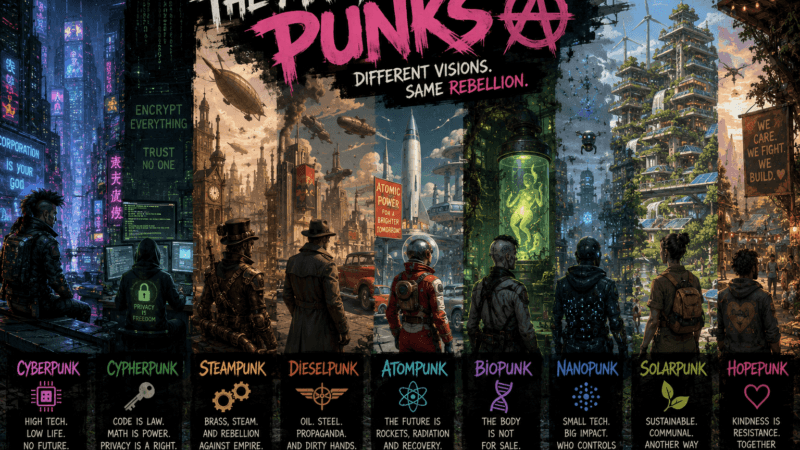
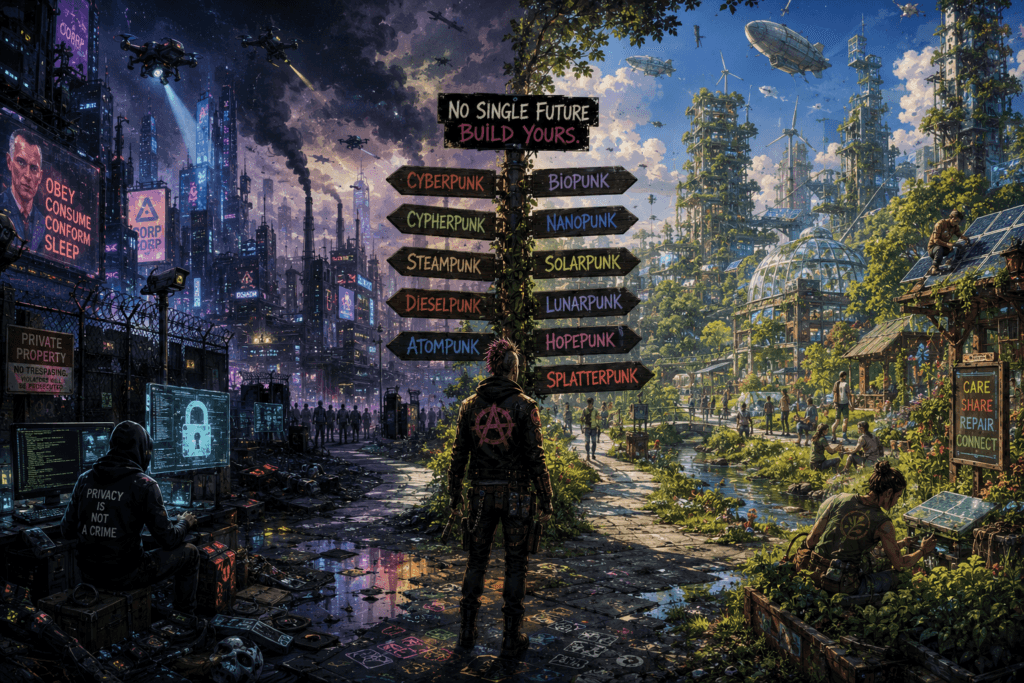
There is a strange little suffix that keeps attaching itself to science fiction, technology culture, design movements, political manifestos, fashion scenes, and internet arguments: punk.
Cyberpunk. Steampunk. Solarpunk. Cypherpunk. Dieselpunk. Biopunk. Nanopunk. Hopepunk. Atompunk. Stitchpunk. Lunarpunk. Splatterpunk, if you enjoy your rebellion served with a mop and a biohazard bag.
At first glance, it looks like lazy taxonomy. Take a technology, bolt “punk” onto the end, add some goggles, neon, fungus, encryption keys, or solar panels, and congratulations: you have a subgenre. The marketing department can go home early.
But the “punk” suffix has survived because it does something useful. It signals that this is not just a decorative future. It is not only about whether the machines are powered by steam, diesel, sunlight, DNA, nanobots, or suspiciously glowing corporate middleware. It is about who controls the machines, who gets crushed by them, and who crawls through the vents with a soldering iron, a manifesto, and a dangerously improvised plan.
The punks are futures with attitude. Some are warnings. Some are dreams. Some are retroactive complaints about industrial capitalism wearing a top hat. Some are technical blueprints disguised as literature. Some are aesthetic mood boards that accidentally developed political theory.
And somewhere beneath all the brass gears, wetware, encryption keys, rooftop gardens, and chrome skull implants, they all ask the same basic question: what happens when ordinary people are forced to live inside someone else’s system?
Punk Before the Prefix
Before cyberpunk became a literary label, punk was already a cultural weapon. Punk was not just loud music and questionable hair architecture. It was refusal. It was do-it-yourself culture. It was distrust of institutions, glossy professionalism, corporate polish, and the idea that only approved experts should be allowed to make noise.
That matters because the best “punk” genres are not simply aesthetics. They inherit that refusal.
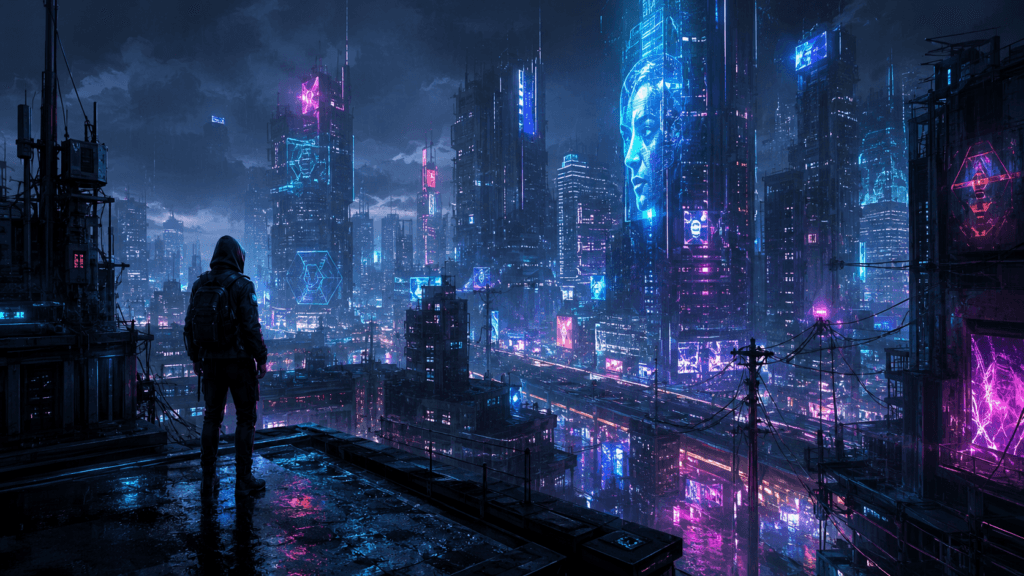
A world is not cyberpunk merely because it has neon signs and someone wearing a long coat in the rain. That is just Blade Runner cosplay with electrical bills. A world becomes cyberpunk when technology has advanced faster than justice, when corporations behave like governments, when the street finds its own uses for broken systems, and when the hero is less “chosen one” and more “underpaid contractor with root access.”
Likewise, solarpunk is not just houses with plants on them. Steampunk is not just brass goggles. Cypherpunk is not just liking cryptocurrency while misunderstanding threat models. The punk part implies friction. It implies a counterforce. It says: someone built a machine, and someone else is trying to reclaim it.
The suffix works because technology is never neutral in these genres. It always has politics. Sometimes it has firmware updates too, which is worse.
Cyberpunk: High Tech, Low Life, Bad Weather
Cyberpunk is the ur-punk of modern speculative tech culture. The word itself came from Bruce Bethke’s short story “Cyberpunk,” written around 1980 and published in 1983, then popularized by editor Gardner Dozois in the 1980s as a label for hard-edged, high-tech science fiction. Bethke reportedly coined it by combining “cybernetics” with “punk,” which is almost disappointingly literal, but also perfect. (Wikipedia)
The genre became closely associated with writers such as William Gibson, Bruce Sterling, Pat Cadigan, Rudy Rucker, John Shirley, and others who understood that computers were not going to arrive as clean academic tools sitting politely in research labs. They were going to leak into finance, crime, sex, surveillance, identity, art, and war. They were going to create new elites and new underclasses. They were going to make the future look less like NASA and more like a vending machine hacked to dispense amphetamines.
Cyberpunk’s classic slogan is “high tech, low life.” It is a compact little packet of cultural checksum data. The technology is advanced, but society is not. Artificial intelligence, neural interfaces, global networks, cloned bodies, corporate security teams, cybernetic limbs, and immersive virtual spaces exist alongside poverty, addiction, social fragmentation, decaying infrastructure, and people doing deeply questionable things in alleyways behind noodle bars.

This is why cyberpunk still feels relevant. It predicted neither smartphones nor social media in exact detail, but it absolutely understood the emotional architecture of the networked age. It understood that cyberspace would not be a clean library of knowledge. It would be a battlefield, a shopping mall, a casino, a surveillance grid, a red-light district, a propaganda pipe, and a place where teenagers learn things their parents cannot pronounce.
The ideology of cyberpunk is generally anti-authoritarian, but rarely optimistic. It distrusts both the state and the corporation, though it often gives the corporation the sharper teeth. In cyberpunk, the future has been privatized. National borders still exist, but power has migrated into boardrooms, data centers, orbital platforms, biotech labs, and security contracts. The police may still show up, but they are often just another interface to capital.
Cyberpunk is also deeply technical in spirit. Not always accurate, but technical. It loves systems: networks, protocols, implants, black markets, identity layers, simulation spaces, information flows. The hacker is not just a character class. The hacker is the person who knows the world has an admin panel.
And yet cyberpunk has a strange failure mode. It was meant as critique, but became product design. The neon dystopia got franchised. The corporate future put on a leather jacket and sold itself back to us as lifestyle. “Wake up, samurai, we have a city to burn” became something you can put on a T-shirt manufactured by a company with a privacy policy longer than a novella.
This is probably cyberpunk’s most cyberpunk outcome.

Cypherpunk: Privacy for the People Who Read the Source Code
If cyberpunk is the literary fever dream of networked society, cypherpunk is what happens when people decide to implement the countermeasures.
Cypherpunk emerged from the cryptographic and hacker communities around the early 1990s. The Cypherpunks mailing list was founded in 1992 by figures including Eric Hughes, Timothy C. May, and John Gilmore, and the name itself was reportedly coined by Jude Milhon as a play on “cipher” and “cyberpunk.” By the mid-1990s, the list had hundreds of subscribers and became a major forum for cryptography, privacy, politics, mathematics, software, and occasional flaming of the old-school internet variety. (Wikipedia)
Cypherpunk is less an aesthetic genre and more a technical-political movement. Its central claim is brutally simple: privacy cannot rely on permission. If private communication depends on governments, corporations, or network operators deciding to behave nicely, then privacy is not a right. It is a temporary configuration option.
Eric Hughes’ “A Cypherpunk’s Manifesto” from 1993 famously argued that cypherpunks write code. That sentence remains one of the most important differences between cypherpunk and many other political subcultures. Cypherpunk was not satisfied with arguing that privacy was morally good. It wanted tools: public-key encryption, remailers, digital cash, anonymous communication, secure messaging, cryptographic signatures, deniable systems, and protocols that treated institutional trust as a bug.
This is also where the movement becomes technically fascinating. Cypherpunk is built around the idea that mathematics can alter power. Strong encryption gives individuals the ability to communicate without centralized approval. Digital signatures allow verification without hierarchy. Anonymous remailers and onion routing challenge traffic analysis and surveillance. Cryptographic money, at least in its original ideological framing, was an attempt to separate exchange from state and banking infrastructure.
The results are mixed, because humans got involved.
Some cypherpunk ideas became essential public infrastructure. TLS, PGP, Signal-style messaging, disk encryption, Tor, secure software distribution, code signing, and end-to-end encrypted communication all carry pieces of the cypherpunk worldview, even when used by people who have never heard the word. Other branches mutated into speculative finance, libertarian fever dreams, NFT goblin markets, and startup pitch decks containing the phrase “trustless community” without irony.
Still, the core cypherpunk insight has aged disturbingly well. The internet did not become a decentralized republic of knowledge. It became a stack of chokepoints. ISPs, app stores, cloud platforms, identity providers, payment processors, ad networks, analytics brokers, and governments all discovered that control is easiest when everyone walks through the same doors.
Cypherpunk says: build other doors. Better yet, build tunnels. Then publish the protocol.
Steampunk: The Future That the Victorians Were Not Allowed to Have
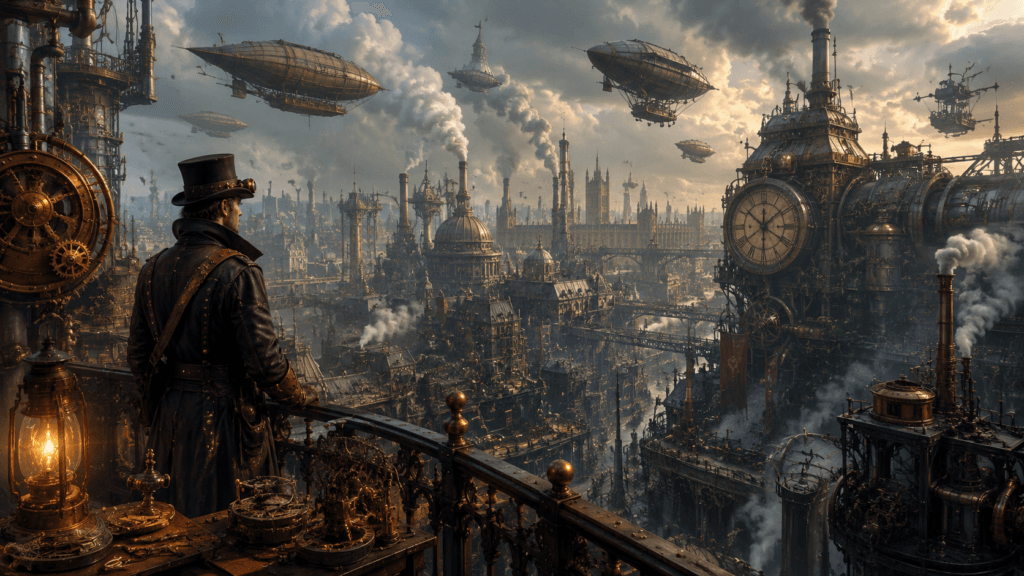
Steampunk is often treated as cyberpunk’s sepia-toned cousin: less neon, more brass; fewer neural implants, more suspiciously ornate pressure gauges. The term was coined by science fiction author K. W. Jeter in a 1987 letter to Locus as a tongue-in-cheek variant of cyberpunk, used to describe Victorian-influenced speculative fiction by writers such as Jeter himself, Tim Powers, and James Blaylock. (Watch City Steampunk Festival)
But steampunk is more interesting than its accessories.
At its best, steampunk is an alternate industrial revolution. It asks what might have happened if mechanical computation, steam power, clockwork automation, airships, analog cybernetics, and Victorian scientific ambition had developed in stranger directions. It is Charles Babbage’s ghost haunting a machine shop. It is Ada Lovelace with a funding grant and a sidearm. It is the 19th century discovering the command line before discovering labor rights.
Aesthetically, steampunk draws on brass, leather, wood, glass, rivets, pressure vessels, telegraphs, gears, corsets, waistcoats, goggles, and machines whose designers believed every component should be visible and slightly dangerous. Unlike modern consumer electronics, which hide their workings behind sealed slabs of black glass, steampunk machines want you to see the mechanism. They are repairable, legible, and likely to remove a finger if operated carelessly.
That visible machinery gives steampunk a particular ideological flavor. It often contains nostalgia for a world where technology was tactile and understandable. But that nostalgia is dangerous if left unexamined, because the actual Victorian era was not a cozy maker fair. It was empire, extraction, child labor, class brutality, colonial violence, disease, soot, and industrial capitalism with facial hair.
Good steampunk knows this. Weak steampunk just glues gears onto a top hat. Strong steampunk interrogates the machine age. It asks who paid for the brass. Who mined the coal. Who cleaned the factories. Who was displayed as exotic, who was classified, who was conquered, who was experimented on, and who was told that progress required their suffering.
So the ideology of steampunk splits in two. One branch is romantic retrofuturism: beautiful machines, eccentric inventors, airships, adventure, and handmade rebellion against sterile modernity. The other branch is industrial critique: a way to revisit the birth of modern capitalism and ask whether the machine was ever innocent.
The answer, predictably, is no. But it did have excellent typography.
Dieselpunk: Art Deco, Engines, War Machines, and the Smell of Hot Oil
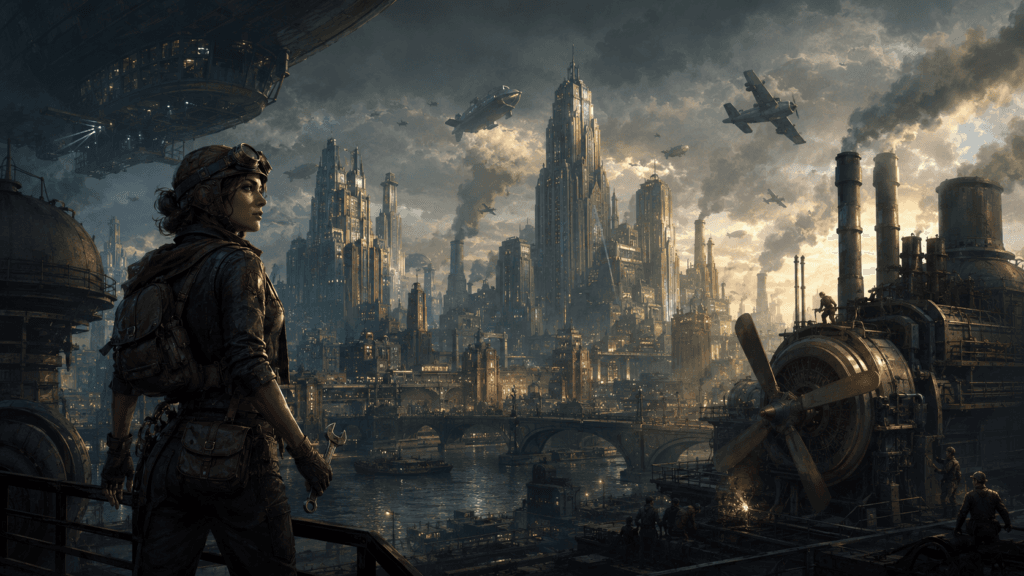
Dieselpunk moves the retrofuturist dial forward from steam to the diesel age. Its reference points are the interwar period, World War II, early Cold War industry, noir, pulp adventure, jazz, Art Deco, Bauhaus, propaganda posters, aviation, tanks, streamlined trains, cigarette smoke, and engines large enough to require both mechanics and moral compromise. The term “dieselpunk” was coined in 2001 by game designer Lewis Pollak in connection with the tabletop role-playing game Children of the Sun. (Wikipedia)
Where steampunk looks at the industrial revolution, dieselpunk looks at modernity discovering mass production, total war, radio, aviation, mechanized logistics, propaganda, and bureaucracy. This is the world where technology scales. Not just one eccentric inventor in a workshop, but factories, armies, corporations, ministries, fleets, and systems.
Dieselpunk’s machines are heavier than steampunk’s and less polite. They burn fuel. They leave stains. They have serial numbers. They arrive by convoy. They are designed by committees and deployed by regimes.
This gives dieselpunk a darker ideological center. It is fascinated by the machine age, but haunted by fascism, war, militarism, industrialized death, and the seduction of strong aesthetics attached to monstrous politics. Art Deco looks great on a poster. It also looks great on the side of a ministry that would very much like to see your papers.
Dieselpunk often lives in alternate histories where the 1930s and 1940s never quite ended, or where their technologies evolved sideways into walking tanks, impossible aircraft, mechanical computers, diesel-powered cities, and noir megastates. Its heroes are pilots, mechanics, spies, smugglers, resistance fighters, detectives, and damaged people in excellent coats standing under ceiling fans while history reloads.
If cyberpunk says corporations ate the future, dieselpunk says the 20th century put the future into uniform.
Atompunk: The Future With Tailfins and Fallout
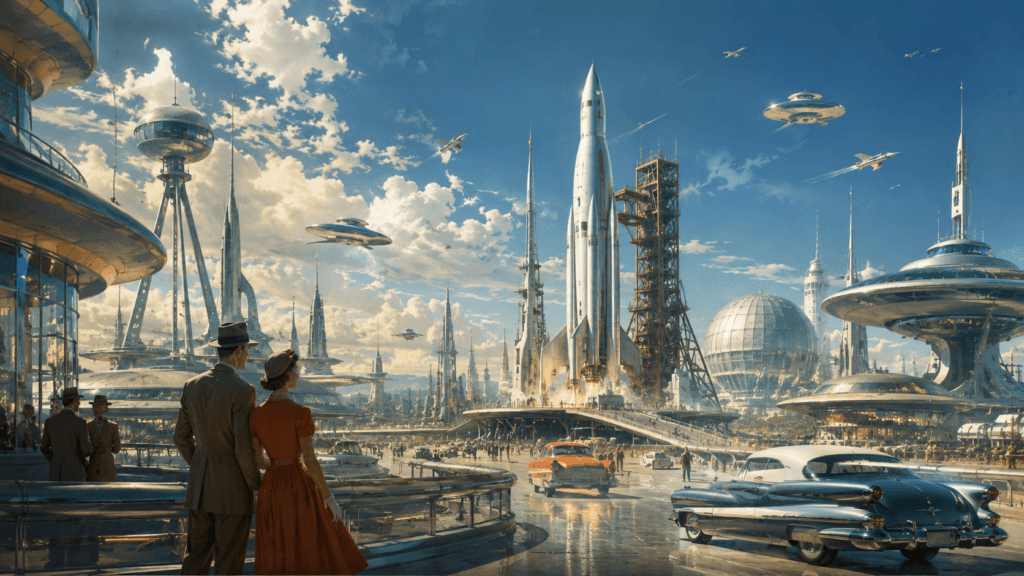
Atompunk belongs to the atomic age: roughly the post-war 1940s through the early space age, though like all retrofuturist genres it treats chronology as a parts bin. It draws on nuclear power, early computers, rockets, radar, Cold War paranoia, suburbia, space race optimism, civil defense drills, ray guns, bubble helmets, mainframes, chrome diners, and the peculiar belief that every household appliance should look prepared for orbit.
Atompunk is the future imagined by people who had seen the bomb and then tried to sell refrigerators anyway.
Its ideological tension is between utopia and annihilation. On one side, atomic energy promised endless power, space exploration, scientific progress, and a gleaming tomorrow of automated homes and flying cars. On the other side, the same physics promised mushroom clouds, fallout shelters, mutually assured destruction, and schoolchildren practicing how to hide under desks from geopolitics.
That duality makes atompunk both playful and eerie. It can be bright, optimistic, and kitschy, but the Geiger counter is always clicking somewhere in the background. Its technology is big-state technology: national laboratories, military contracts, aerospace programs, centralized planning, megaprojects, and scientists with security clearances.
The punk element in atompunk often comes from puncturing official optimism. It asks what happens when the cheerful brochure future is built on radioactive waste, military secrecy, suburban conformity, and the assumption that experts in lab coats definitely have everything under control.
Spoiler: they do not.

Biopunk: The Body as Firmware
Biopunk shifts the site of technological conflict from the machine to the organism. It is derived from cyberpunk but replaces the dominant concern with information technology and cybernetics with biotechnology, genetic engineering, synthetic biology, cloning, wetware, biohacking, pharmaceutical control, and corporate ownership of life itself. (Wikipedia)
If cyberpunk asks who owns your data, biopunk asks who owns your cells.
This is a particularly uncomfortable genre because it removes the comforting boundary between tool and user. In cyberpunk, you can imagine unplugging from the network, even if the genre usually laughs at you for trying. In biopunk, the network is inside the body. Your immune system has an API. Your genome has licensing terms. Your organs may require a subscription. Somewhere, a biotech company has patented a repair mechanism your grandmother’s mitochondria considered standard equipment.
Biopunk worlds are full of gene hackers, black-market clinics, engineered plagues, designer drugs, modified humans, corporate labs, experimental therapies, synthetic organisms, and ethical committees arriving just after the disaster. The body becomes a platform, and like all platforms, it attracts developers, investors, criminals, regulators, and people who insist the beta release is safe.
The ideology of biopunk is about bodily autonomy under technological capitalism. Who gets access to enhancement? Who becomes experimental material? Who controls reproduction, disease resistance, cognitive modification, lifespan extension, or engineered adaptation? What happens when inequality becomes biological rather than merely economic?
Biopunk also has a strong DIY biology angle. Real-world biohackers and community labs are not usually producing dystopian vat-grown assassins, despite what the more excitable corners of fiction suggest. But they do challenge the idea that biotechnology should belong only to corporations, universities, and states. That makes biopunk one of the punks where the garage-lab spirit is unusually literal.
It is cyberpunk with petri dishes. Which is to say: still dangerous, but now the contamination protocol matters.
Nanopunk: The Revolution You Accidentally Inhaled
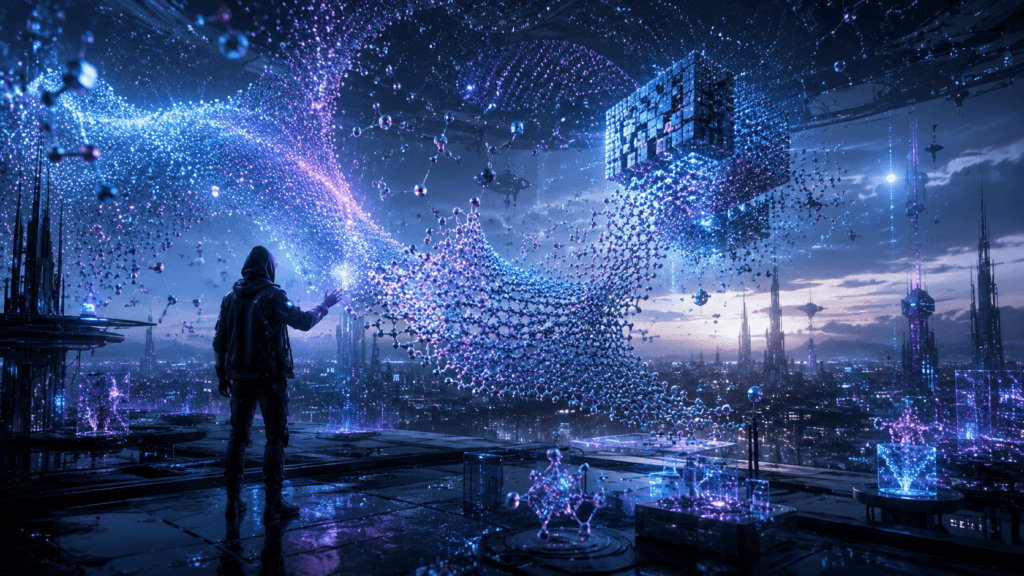
Nanopunk is a younger and more specialized cousin of cyberpunk and biopunk. It imagines societies transformed by nanotechnology, nanobots, molecular engineering, programmable matter, medical nanites, material abundance, microscopic surveillance, and all the other consequences of learning to manipulate matter at absurdly small scales. (Wikipedia)
Nanopunk’s core anxiety is control at the invisible level.
In cyberpunk, surveillance cameras can be avoided. In biopunk, a lab can at least theoretically be burned down by angry villagers with a strong sense of narrative tradition. In nanopunk, the system may be in the air, the water, the walls, your bloodstream, your clothes, or the dust on your desk. The interface has vanished. The machine is everywhere because it is too small to see.
This creates interesting ideological questions. If matter becomes programmable, scarcity changes. Manufacturing changes. Medicine changes. Warfare changes. Borders change. Privacy becomes almost absurdly difficult. Environmental remediation might become possible on a massive scale, but so might environmental sabotage. A nanotechnological society could be a post-scarcity miracle or a total surveillance nightmare with better materials science.
Nanopunk is therefore less visually stable than steampunk or cyberpunk. It does not have one iconic silhouette. No goggles, no trench coat, no mandatory neon. Its horror and wonder come from systems below perception. The genre is at its best when it treats nanotechnology not as magic dust, but as infrastructure. Who controls the assemblers? Who audits the molecular machines? Who patches the firmware of the particles currently rebuilding your liver?
And, inevitably, who forgot to disable telemetry?

Solarpunk: The Future That Refuses to Be a Smoking Crater
Solarpunk is one of the most important newer punk movements because it does something rare in speculative culture: it imagines a future worth living in without pretending the present is fine.
Solarpunk is a literary, artistic, and social movement focused on sustainable futures, renewable energy, ecological repair, community, decentralization, and a rejection of climate doomerism. The “solar” part points toward renewable energy and ecological optimism, while the “punk” part often points toward DIY culture, countercultural politics, post-capitalist imagination, and resistance to extractive systems. (Wikipedia)
This makes solarpunk a direct answer to cyberpunk’s exhausted dystopia. Cyberpunk says the future is neon advertisements reflected in polluted rain. Solarpunk says maybe the future could be public transit, food forests, community workshops, open hardware, passive housing, local resilience, repair culture, and solar panels installed by people who know their neighbors’ names.
But solarpunk is often misunderstood as naive. That is unfair. Bad solarpunk is naive, yes, but bad cyberpunk is just a screensaver with depression. Good solarpunk is not “everything is nice now.” It is a theory of struggle. It understands climate change, ecological collapse, inequality, colonial extraction, corporate greenwashing, and infrastructure decay. Its optimism is not passive. It is engineered.
The ideology of solarpunk is practical hope. It asks how humans can live well within ecological limits. It favors decentralization, repairability, commons-based systems, local production, permaculture, social justice, mutual aid, appropriate technology, and cities designed for humans rather than cars and quarterly profits.
Solarpunk is also quietly technical. The aesthetic may be gardens on rooftops, but the underlying questions are engineering questions: energy storage, grid resilience, heat management, water systems, soil regeneration, material lifecycles, housing density, public transit, agricultural methods, open-source hardware, and the maintenance burden of all those beautiful systems after the grant money runs out.
That last part matters. A believable solarpunk future has maintenance schedules. Compost logistics. Spare parts. Governance meetings. People arguing about whether the community battery system should prioritize the clinic, the bakery, or Jens’ ridiculous home server rack.
Especially Jens’ home server rack.

Lunarpunk: Solarpunk’s Nocturnal Sibling
Lunarpunk is often treated as the mystical, night-side cousin of solarpunk. Where solarpunk is sunlit, communal, ecological, and often architectural, lunarpunk leans into darkness, cycles, spirituality, fungi, hidden networks, water, moonlight, ritual, care, and the less visible parts of ecological life.
It is less established than cyberpunk, steampunk, or solarpunk, but it fills a useful gap. Solarpunk can sometimes become too clean, too bright, too architectural-render friendly. Lunarpunk reintroduces mystery, grief, decay, and the fact that healthy ecosystems include rot. It is the compost bin reminding the solar panel that not all progress is shiny.
Ideologically, lunarpunk often overlaps with ecofeminism, animism, decolonial ecology, queer futurism, mutual aid, and alternative ways of knowing. It is skeptical of the idea that the future must be solved only by engineering dashboards. It asks for relationship, ritual, and attention to the unseen.
Technically minded people may be tempted to dismiss this as vibes. That would be a mistake. Every real system has invisible dependencies. Soil microbiomes, groundwater cycles, pollinators, maintenance labor, emotional resilience, informal care networks, and trust are all infrastructure. They just do not always appear in the architecture diagram.
Lunarpunk says: draw the hidden layers too.

Hopepunk: Kindness as Sabotage
Hopepunk was coined by fantasy author Alexandra Rowland in 2017 as a response to grimdark, the flavor of speculative fiction where everything is awful, everyone is compromised, and the moral universe has been replaced by a wet parking lot. Hopepunk centers characters fighting for positive change, often through radical kindness, solidarity, and communal resistance. (Wikipedia)
The key word is fighting. Hopepunk is not passive optimism. It is not putting up a motivational poster in a burning server room. It is the belief that care itself can be oppositional in systems built on cruelty, exhaustion, alienation, and despair.
This is why hopepunk belongs in the punk family, even though it is less tied to a specific technology. Its rebellion is ethical rather than mechanical. It rejects cynicism as sophistication. It says that in a world optimized for extraction, choosing solidarity is not soft. It is insurgent.
There is a technical version of this too. Open-source maintainers helping strangers for free. Mutual aid groups building crisis infrastructure. Community mesh networks after disasters. People documenting obscure bugs so the next poor soul does not spend six hours swearing at the same stack trace. These are not glamorous acts, but they keep systems alive.
Hopepunk is the emotional opposite of nihilistic cyberpunk, but not its enemy. In fact, the two need each other. Cyberpunk diagnoses the machinery of oppression. Hopepunk asks why we should bother resisting it. Solarpunk then shows up with a community planning document and asks whether anyone brought snacks.

Splatterpunk: When Subtlety Leaves Through the Emergency Exit
Splatterpunk emerged as a horror movement rather than a technology-future genre, but it deserves a place in the punk taxonomy because it shares the same rejection of polite boundaries. Splatterpunk is graphic, confrontational horror that refuses the tasteful fade-to-black. It is punk in the sense that it rejects respectability and forces the body back into the room.
Where cyberpunk externalizes social anxiety through networks and corporations, splatterpunk externalizes it through flesh, gore, violation, and disgust. It is not always clever, and it is very much not always good, but the best splatterpunk uses excess as critique. It says that beneath civilized surfaces are systems of violence that polite culture would prefer not to see.
In the broader “punk” map, splatterpunk reminds us that genre rebellion is not always optimistic or stylish. Sometimes it is messy, offensive, and deliberately unpleasant. Not every punk wants to build a better future. Some just want to drag the present under fluorescent lights and ask why it smells like that.
Stitchpunk, Clockpunk, Stonepunk, and the Taxonomic Junk Drawer
Once the suffix became productive, it started reproducing in the wild. Some descendants are useful. Some are niche. Some feel like they were generated by rolling dice over a museum catalog.
Clockpunk is usually pre-industrial or Renaissance-flavored speculative fiction built around clockwork, springs, automata, and intricate mechanical devices rather than steam engines. It is Leonardo da Vinci with a production budget. Stonepunk imagines prehistoric or ancient technologies pushed into speculative exaggeration. Stitchpunk is associated with handmade, sewn, doll-like, or textile-based worlds, often with an eerie crafted fragility.
These smaller punks often work best as aesthetic lenses rather than full ideological movements. Clockpunk can explore mechanism, craftsmanship, and early scientific imagination. Stonepunk can play with the origins of tool use and social organization. Stitchpunk can explore vulnerability, repair, embodiment, and the uncanny life of handmade things.
But this is where we should be careful. Not every “somethingpunk” is automatically profound. Sometimes the suffix just means “this has a look.” That is fine. Not everything needs a manifesto. But the stronger the punk, the more it says about power.
A good test is this: if you remove the aesthetic, does the genre still have a conflict?
If cyberpunk loses neon, it still has corporate domination, surveillance, and hacker resistance. If solarpunk loses rooftop gardens, it still has ecological repair and anti-extractive politics. If cypherpunk loses the cool name, it still has cryptographic self-defense. If steampunk loses goggles, it still has industrial modernity and empire to interrogate.
If a genre loses its costume and nothing remains, it may not be punk. It may just be wardrobe.
The Ideological Family Tree
The punks can be grouped by the systems they rebel against.
Cyberpunk rebels against corporate information society. Its enemy is the network as control grid. Cypherpunk rebels against surveillance and centralized trust. Its weapon is cryptography. Steampunk rebels against sanitized industrial nostalgia by exposing empire, class, and machinery. Dieselpunk rebels inside the age of mass industry, propaganda, and mechanized war. Atompunk rebels against Cold War techno-optimism and centralized megaprojects. Biopunk rebels over bodily autonomy and genetic control. Nanopunk rebels at the level of matter itself. Solarpunk rebels against ecological collapse and capitalist fatalism. Lunarpunk rebels against sterile rationalist futures that forget hidden systems. Hopepunk rebels against despair.
That is the shared DNA: each punk identifies a dominant system and imagines people living against it.
This is why the suffix still matters. It marks a genre as adversarial. Not always revolutionary, not always coherent, and not always politically pure, but adversarial. It says the world is not merely a setting. The world is a system of constraints.
The protagonist does not just explore the world. They route around it.
Why the Punks Keep Multiplying
The multiplication of punk genres is partly internet taxonomy doing what internet taxonomy does: naming increasingly specific vibes until someone invents “fermentationpunk” and starts a Discord server about anarchist cheese caves.
But there is a deeper reason. Each punk genre captures anxiety about a particular technological or social transition.
Cyberpunk emerged as computers, networks, globalization, Japanese corporate power, and late capitalism reshaped the 1980s imagination. Cypherpunk emerged when cryptography moved from military and academic circles toward public digital life. Steampunk grew from both Victorian retrofuturism and modern discomfort with industrialization. Dieselpunk reflects fascination and horror around the early 20th century’s engines of war and mass culture. Atompunk processes the nuclear age. Biopunk and nanopunk respond to biotechnology and molecular engineering. Solarpunk and hopepunk respond to climate grief, political exhaustion, and the desire for futures that are not just different flavors of collapse.
In other words, the punks are not random. They are cultural debugging tools.
Each one points at a subsystem and says: this is where the future feels broken.
Cyberpunk debugs the network. Cypherpunk debugs trust. Steampunk debugs industrial progress. Dieselpunk debugs mass modernity. Atompunk debugs scientific nationalism. Biopunk debugs the body. Nanopunk debugs matter. Solarpunk debugs ecology. Hopepunk debugs despair.
Some of those bugs are now production features.
The Problem With Aesthetic Rebellion
Of course, capitalism has a talent for eating its critics, digesting the dangerous parts, and selling the rest as premium lifestyle accessories.
Cyberpunk becomes RGB keyboards and corporate metaverse demos. Steampunk becomes wedding décor. Solarpunk becomes luxury real-estate renders with trees on balconies and no visible poor people. Cypherpunk becomes venture-funded “decentralized” platforms where three cloud providers host the entire revolution. Hopepunk becomes cozy branding. Dieselpunk becomes cool fascist-adjacent uniforms if handled by people with the political literacy of a damp sock.
This is the great danger of every punk genre: the aesthetic survives while the critique is removed.
A neon city is not cyberpunk if nobody is trapped in its systems. A solar-powered city is not solarpunk if it is a gated community for climate survivors. A brass prosthetic is not steampunk if the story has no interest in class, empire, labor, or industrial power. Encryption is not cypherpunk if the keys are held by the platform. Kindness is not hopepunk if it requires ignoring injustice.
The punk part must remain inconvenient. It should make the genre harder to consume, not easier. It should leave grease on your hands.
The Most Useful Punk for Right Now
So which punk do we need most?
The easy answer is solarpunk, because the planet is overheating and we could use fewer dystopias that treat collapse as an edgy backdrop. Solarpunk is valuable because it insists that futures can be built, not merely survived.
But the more accurate answer is that we need several at once.
We need cyberpunk’s suspicion of corporate power. We need cypherpunk’s insistence that rights require tools, not just policies. We need solarpunk’s practical optimism. We need biopunk’s concern for bodily autonomy in an age of genetic data, reproductive technology, synthetic biology, and medical platforms. We need atompunk’s memory that scientific progress without democratic accountability can become existentially stupid very quickly. We need hopepunk’s refusal to mistake cynicism for intelligence.
And we probably need steampunk’s repair culture too, minus the colonial nostalgia and with fewer unnecessary goggles.
The future will not be one genre. It will be a messy stack. A solar-powered community mesh network using encrypted communication, open hardware, repaired laptops, local food production, bioengineered medicine, recycled materials, and a governance meeting where everyone argues for three hours about battery storage is not cleanly cyberpunk or solarpunk or cypherpunk.
It is just the future doing what the future always does: arriving badly documented.
Conclusion: Keep the Punk in the Punk
The “punk” suffix survives because it reminds us that technology is never just technology. It is power made operational. A protocol is politics. A city layout is politics. A battery supply chain is politics. A genome database is politics. A cloud account is politics with a login screen.
The best punk genres understand this. They do not merely decorate the future. They interrogate it. They ask who benefits, who pays, who is watched, who is modified, who is excluded, who repairs the system, who can leave, and who gets root.
Cyberpunk gave us the future as a hostile network. Cypherpunk gave us tools for resisting surveillance inside that network. Steampunk and dieselpunk taught us that nostalgia must be cross-examined. Atompunk reminded us that optimism and annihilation can share a laboratory. Biopunk and nanopunk moved the battlefield into the body and the molecule. Solarpunk and hopepunk dared to suggest that survival is not enough; the future should be livable, shared, and worth maintaining.
That may be the real thread connecting all the punks. Not neon. Not brass. Not solar panels. Not cryptographic signatures. Not airships. Not nanites.
Agency.
The right to understand the systems around us. The right to modify them. The right to route around them. The right to build alternatives. The right to refuse futures handed down by institutions that treat ordinary people as users, consumers, subjects, datasets, or spare parts.
A punk future is not necessarily a good future. Cyberpunk is mostly a warning label. Dieselpunk is often a siren heard through factory smoke. Biopunk can be a nightmare with lab access. But all of them contain the same useful irritant: the belief that systems can be challenged.
And that is worth keeping.
Because the moment “punk” becomes only a font choice, the corporations win.
Again.